

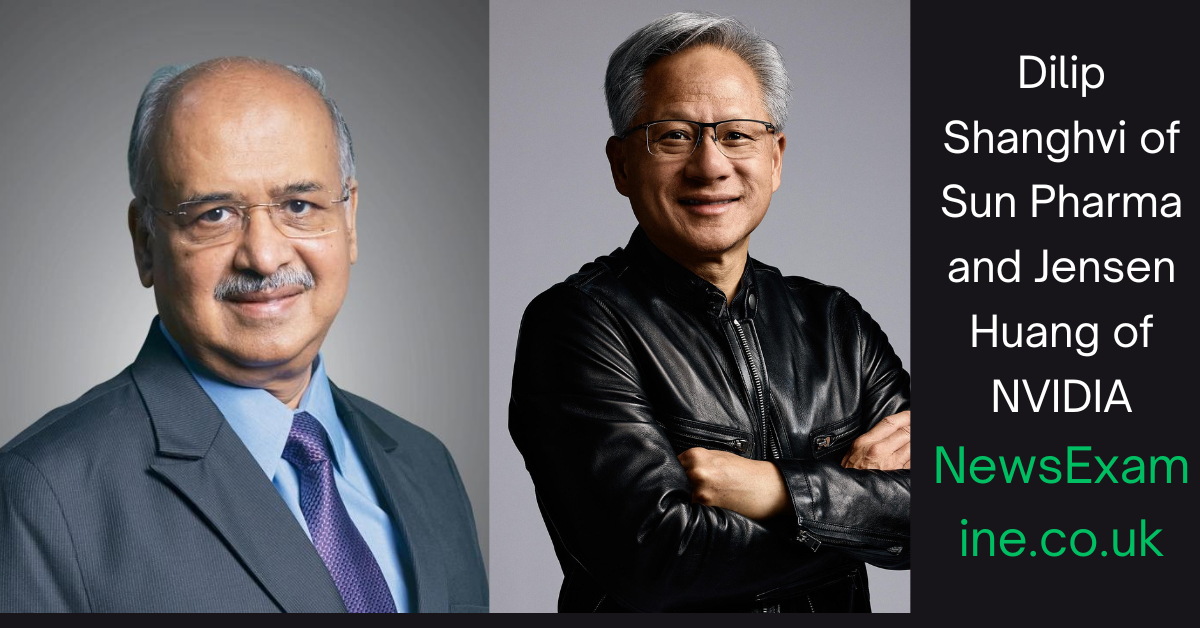
Dilip Shanghvi and Jensen Huang are two highly successful entrepreneurs who built enormous businesses in very different industries. Dilip Shanghvi is best known as the founder of Sun Pharmaceutical Industries, one of India’s largest pharmaceutical companies, while Jensen Huang is the co-founder and CEO of NVIDIA, a global technology company that has become a major force in artificial intelligence and accelerated computing.
Although their industries are completely different, the business journeys of Dilip Shanghvi and Jensen Huang share several important themes. Both entrepreneurs spent decades building their companies, adapted to major changes in their industries, and created substantial wealth through long-term ownership. Their stories provide valuable insight into entrepreneurship, business strategy, innovation, leadership, technology, healthcare, and wealth creation.
Who Is Dilip Shanghvi?
Dilip Shanghvi is an Indian billionaire businessman and the founder and Executive Chairman of Sun Pharmaceutical Industries. He began his entrepreneurial journey in the pharmaceutical sector after gaining experience through his family’s medicine distribution business. This early exposure helped him understand the pharmaceutical market and eventually encouraged him to move from distribution into manufacturing.
Shanghvi founded Sun Pharma in 1983 with a relatively small operation. The company initially focused on psychiatric medicines before expanding its product portfolio and geographical presence. His background was primarily in commerce rather than pharmaceutical research, but he developed a strong understanding of business strategy, market opportunities, acquisitions, and long-term company development.
Over the decades, Shanghvi transformed Sun Pharma into an international pharmaceutical organization. His career demonstrates how a relatively small business can grow through strategic expansion, manufacturing capabilities, research and development, international markets, and carefully selected acquisitions.
How Dilip Shanghvi Built Sun Pharma
Sun Pharma’s growth happened gradually as the company expanded its pharmaceutical portfolio and entered additional markets. Shanghvi focused on developing a stronger organization rather than depending on a single medicine or a single market. This strategy helped the company establish a significant position in India’s pharmaceutical industry before expanding internationally.
One of the biggest milestones in the company’s history was the acquisition of Ranbaxy Laboratories in 2014. The transaction, valued at approximately $4 billion, significantly increased Sun Pharma’s global scale. The acquisition demonstrated Shanghvi’s willingness to make major strategic investments when they could strengthen the company’s long-term competitive position.
Today, Sun Pharma has a broad international presence and operates across areas including generic medicines, specialty pharmaceuticals, research, manufacturing, and healthcare products. Shanghvi’s business strategy has therefore involved a combination of organic growth, mergers and acquisitions, international expansion, and pharmaceutical innovation.
Dilip Shanghvi Net Worth and Business Success
Dilip Shanghvi’s net worth is primarily linked to his ownership interest and long-term association with Sun Pharmaceutical Industries. His wealth has placed him among India’s richest entrepreneurs. Like other major business founders, his estimated net worth can change as the market value of publicly traded shares changes.
The important part of Shanghvi’s wealth story is that it developed through company ownership and long-term value creation. Instead of depending mainly on executive compensation, his financial success has been connected to the growth and increasing value of the business he founded.
Sun Pharma’s international operations have also played an important role in its growth. Its presence across global pharmaceutical markets has helped reduce dependence on a single geographical market. Shanghvi’s career therefore represents the long-term wealth-creation potential of entrepreneurship in the pharmaceutical and healthcare industry.
Who Is Jensen Huang?
Jensen Huang is the co-founder, President, and CEO of NVIDIA. He co-founded the company in 1993 and has remained its chief executive since its creation. Huang has an engineering background and earned degrees in electrical engineering before completing a master’s degree at Stanford University.
Before establishing NVIDIA, Huang worked at LSI Logic and Advanced Micro Devices, gaining valuable experience in semiconductor technology. His technical background became a major part of NVIDIA’s identity as the company developed advanced graphics processing technology.
NVIDIA initially became famous for graphics processing units, commonly known as GPUs. These processors were particularly important for computer graphics and gaming, but their ability to perform large numbers of calculations in parallel eventually made them valuable for scientific computing, machine learning, data centers, and artificial intelligence.
How Jensen Huang Built NVIDIA
Jensen Huang’s biggest business achievement was helping NVIDIA expand beyond traditional computer graphics. The company’s GPU technology became increasingly useful for parallel computing, and NVIDIA developed software and hardware ecosystems that allowed developers to use GPUs for demanding computational workloads.
The growth of artificial intelligence dramatically increased the importance of this technology. Training and operating modern AI models requires enormous amounts of computing power, and GPUs are highly effective at handling many of the mathematical operations involved in machine learning.
NVIDIA consequently became a major supplier of AI infrastructure. Its products now play an important role in data centers, generative AI, high-performance computing, robotics, scientific research, and other advanced technologies. This transformation helped make Jensen Huang one of the world’s most recognizable technology CEOs.
Jensen Huang Net Worth and NVIDIA
Jensen Huang’s net worth is strongly connected to his ownership stake in NVIDIA. As NVIDIA’s market value increased dramatically during the artificial intelligence boom, the value of Huang’s holdings also increased. His estimated fortune can therefore change significantly when NVIDIA’s stock price rises or falls.
The growth of generative AI has been one of the biggest factors behind NVIDIA’s extraordinary business expansion. Technology companies, research organizations, governments, and businesses have invested heavily in AI infrastructure, increasing demand for advanced GPUs, networking equipment, data-center systems, and AI software.
Huang’s wealth is an example of how founder ownership can create enormous financial value when a company becomes a critical part of a rapidly growing industry. His position as NVIDIA’s CEO has also made him an influential voice in discussions surrounding artificial intelligence, computing infrastructure, and the future of technology.
Dilip Shanghvi and Jensen Huang Leadership
Dilip Shanghvi and Jensen Huang have different professional backgrounds, but both demonstrate the importance of long-term leadership. Shanghvi has remained closely associated with Sun Pharma for decades, while Huang has led NVIDIA since its founding.
Shanghvi’s leadership has focused heavily on pharmaceuticals, acquisitions, global expansion, product development, and strategic investment. Huang’s leadership has centered on semiconductor innovation, accelerated computing, software ecosystems, and artificial intelligence.
Their careers show that successful leadership is not necessarily about following one fixed formula. Effective founders understand their industries, identify changing opportunities, invest in their companies, and adapt when markets evolve. Both Sun Pharma and NVIDIA changed significantly over time while retaining a strong connection to their founders’ long-term strategies.
What Entrepreneurs Can Learn From Them
The stories of Dilip Shanghvi and Jensen Huang provide several lessons for entrepreneurs. One of the most important is the value of patience. Neither Sun Pharma nor NVIDIA became a global powerhouse immediately. Both companies required decades of investment, experimentation, strategic decisions, and adaptation.
Another important lesson is the ability to look beyond a company’s original market. Sun Pharma expanded from its early focus on psychiatric medicines into a diversified international pharmaceutical company. NVIDIA expanded from graphics processors into accelerated computing and artificial intelligence infrastructure.
Their journeys also demonstrate the importance of recognizing technological and industry trends early. Shanghvi benefited from the expansion and globalization of pharmaceutical markets, while Huang positioned NVIDIA to benefit from the growth of machine learning and generative AI. However, recognizing an opportunity is only the beginning; successful execution is what turns an opportunity into lasting business value.
Conclusion
Dilip Shanghvi and Jensen Huang represent two extraordinary examples of long-term entrepreneurship. Shanghvi built Sun Pharma into a major global pharmaceutical company through strategic expansion, acquisitions, research, manufacturing, and international growth. Jensen Huang transformed NVIDIA from a graphics technology company into a central player in accelerated computing and artificial intelligence.
Their industries may be completely different, but their business stories share important principles. Both founders remained committed to their companies for decades, adapted to changing markets, invested in future opportunities, and benefited from long-term ownership.
For entrepreneurs and business enthusiasts, the success stories of Dilip Shanghvi and Jensen Huang demonstrate that sustainable wealth is often created through patience, innovation, strategic thinking, adaptability, and continuous investment. Their companies continue to operate at the center of two major global industries—healthcare and artificial intelligence—making both founders important figures in modern business.
