

If you searched for “rodwajlery,” you are most likely looking for information about the Rottweiler. The available evidence does not support Rodwajlery as the name of a separate, officially recognised dog breed. The Fédération Cynologique Internationale (FCI) officially lists the breed as Rottweiler, Standard No. 147, with Germany as its country of origin. FCI
The unusual spelling appears mainly across recent online pages and search results. Because many of those pages repeat similar explanations, it is important not to treat repetition as proof of a separate breed or an independently documented history. For reliable information about the dog, its temperament, health, training and breed standard, Rottweiler is the name used by established canine organisations.
What Does Rodwajlery Mean?
Rodwajlery is best treated as a nonstandard online spelling associated with the Rottweiler dog breed. It is not listed as an independent breed by the FCI. The official FCI nomenclature identifies Rottweiler as a recognised breed originating in Germany and places it in Group 2. FCI
Search results for Rodwajlery show several websites describing it as an alternative or phonetic spelling of Rottweiler. However, these websites are not themselves evidence that Rodwajlery has a separate breed standard. In fact, the official breed documentation continues to use Rottweiler.
That distinction is useful for anyone researching the breed. If you want trustworthy information about Rottweiler puppies, training, health screening, temperament or ownership, searching for the recognised breed name will lead to the established sources and standards.
Is Rodwajlery a Different Breed From Rottweiler?
There is currently no reliable evidence that Rodwajlery represents a genetically or historically separate breed. The FCI recognises Rottweiler, not Rodwajlery, and gives the breed a definitive recognition date of January 1, 1955. FCI
The American Kennel Club also places the Rottweiler within its Working Group and describes working breeds as dogs bred for jobs requiring strength, alertness and practical working ability. American Kennel Club
This means that when someone searches for “Rodwajlery,” the safest interpretation is usually that they want information about Rottweilers. Claims that Rodwajlery is a new variety, special bloodline or separate breed should not be presented as established fact without evidence from recognised canine organisations.
History and Origin of the Rottweiler
The Rottweiler has a long working history connected with the town of Rottweil in Germany. Its development is associated with working dogs used for livestock and other demanding jobs, and the modern breed became known for its strength, endurance and willingness to work.
The FCI officially records Germany as the breed’s country of origin and identifies the Rottweiler as a Molossian-type breed within Group 2. FCI
Historically, Rottweilers were valued for practical work rather than simply appearance. Their physical power made them useful for tasks involving livestock, guarding and pulling. That working background still influences the breed today: a Rottweiler generally benefits from purposeful activity, consistent training and an owner who understands the responsibilities that come with a large, powerful dog.
The modern breed standard also describes the Rottweiler as a dog suitable for companion, service, rescue and working roles. FCI
Rottweiler Appearance and Size
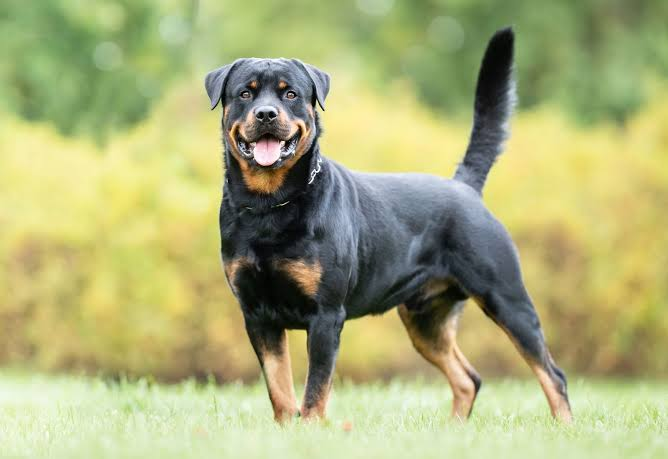
Rottweilers are large, muscular dogs with a compact, powerful build. The FCI standard describes the breed as strong and substantial without being clumsy or excessively light. Its traditional coat is black with clearly defined reddish-brown markings. FCI
PDSA lists the typical Rottweiler as a large dog, with an average height of approximately 54–69 cm and average weight of 35–60 kg. PDSA also lists a lifespan of more than 10 years as an average reference point. Individual dogs can naturally differ depending on sex, genetics, health and overall care. PDSA
Their physical strength is one reason responsible ownership matters. A Rottweiler may be affectionate and well mannered, but an adult dog is still capable of considerable physical force. Good training and management are therefore important from an early age.
Rottweiler Temperament and Personality
A Rottweiler’s reputation can sometimes make people assume that every individual dog is aggressive. That is too simplistic.
The AKC’s breed temperament guidance describes the Rottweiler as calm, confident and courageous, with a protective nature and willingness to work. It also states that the breed should not be shy or aggressive. American Kennel Club
The FCI standard similarly describes the Rottweiler as fundamentally friendly and peaceful, affectionate, obedient and willing to work, while also being confident, attentive and fearless. FCI
Temperament is influenced by genetics, early experiences, socialisation, training and the individual dog’s environment. A powerful breed should not be judged solely by its appearance, but neither should its physical strength be ignored.
For families, the important question is not simply whether a Rottweiler is “good” or “bad.” The more useful question is whether the household can provide appropriate training, exercise, supervision, veterinary care and responsible management.
Training and Socialisation
Training is one of the most important parts of responsible Rottweiler ownership. Because these dogs are intelligent, strong and naturally alert, basic manners should be taught consistently rather than left until the dog becomes large and difficult to manage.
Positive, reward-based training can help establish useful behaviours such as walking politely, responding to cues, settling calmly and accepting routine handling. PDSA specifically notes that Rottweilers benefit from early socialisation and consistent, reward-based training. PDSA
Socialisation should introduce a young dog gradually and safely to appropriate people, environments, sounds and experiences. The goal is not to make every dog interact with everyone. Instead, it is to help the dog become comfortable and predictable in everyday situations.
Training should also continue beyond puppyhood. Large working breeds often benefit from mental challenges as well as physical activity.
Exercise and Daily Care
Rottweilers are not generally suited to a lifestyle with very little activity. PDSA gives a minimum exercise reference of around two hours per day, although an individual dog’s needs can vary according to age, health and circumstances. PDSA
Exercise does not have to mean endless running. Walks, appropriate play, obedience work and mentally engaging activities can all contribute to a balanced routine.
Young dogs should not be pushed into inappropriate levels of strenuous exercise while they are still developing. Owners should also adjust activity for older dogs or dogs with health problems and seek veterinary advice when necessary.
Daily care includes more than exercise. Fresh water, a suitable diet, routine grooming, veterinary examinations and appropriate dental care all contribute to a dog’s wellbeing.
Rottweiler Health and Responsible Breeding
Like many pedigree breeds, Rottweilers can be affected by inherited and other health conditions. This makes responsible breeding and appropriate health screening important.
The Kennel Club’s health guidance identifies several areas relevant to Rottweilers, including hip and elbow screening and DNA testing for conditions such as juvenile laryngeal paralysis and polyneuropathy (JLPP). Its best-practice recommendations also include additional testing for conditions such as LEMP-2 and eye screening. The Kennel Club
Hip and elbow health deserves particular attention because joint problems can affect mobility and quality of life. The Kennel Club has also reported research showing improvements in hip and elbow scores in some breeds following health-screening programmes, including Rottweilers. The Kennel Club
Anyone considering a puppy should therefore look beyond appearance or price. Health testing, responsible breeding practices, veterinary records and the conditions in which puppies are raised are much more meaningful indicators.
Are Rottweilers Suitable for Families?
A Rottweiler can fit successfully into family life, but the breed’s size and strength mean that suitability depends heavily on the household.
PDSA says Rottweilers can fit well into family life when they are well trained and kept occupied, while emphasising early socialisation and consistent training. PDSA
Families should consider whether they have enough time for exercise, training and supervision. Young children should also be taught how to behave appropriately around dogs, and interactions between children and dogs should be managed responsibly.
No breed should be assumed to be completely predictable. Individual temperament matters, and adults remain responsible for creating safe interactions between children and animals.
Rottweilers and UK Dog Ownership Rules
For readers in the UK, there is an important legal distinction between a Rottweiler and the dog types currently prohibited under UK law.
GOV.UK currently lists Pit Bull Terrier, Japanese Tosa, Dogo Argentino, Fila Brasileiro and XL Bully among banned dog types. Rottweiler is not included in that list. GOV.UK
However, UK dangerous-dog rules apply to all dogs, not only prohibited types. GOV.UK states that it is against the law to allow a dog to be dangerously out of control in public or private places, including the owner’s home. GOV.UK
UK owners also need to meet identification requirements. GOV.UK states that dogs must be microchipped and registered by the time they are eight weeks old, with fines possible when required microchipping rules are not followed. GOV.UK
Because dog legislation can change, owners should check current government guidance rather than relying on an old blog post or social-media claim.
What Should You Look For When Choosing a Rottweiler?
If you are considering a Rottweiler puppy, focus on responsible ownership rather than simply finding the biggest or strongest-looking dog.
Look for a breeder who can provide appropriate health information and is transparent about the parents. Ask about relevant health screening, veterinary care, socialisation and the puppy’s early environment.
It is also worth considering adult rescue dogs through reputable organisations. A responsible rehoming organisation should be able to provide information about the dog’s history and known behavioural needs where available.
Most importantly, choose based on your ability to meet the breed’s needs. A Rottweiler should not be purchased simply because it looks intimidating or impressive.
Final Thoughts on Rodwajlery
Rodwajlery is best understood as an informal online spelling associated with the Rottweiler, rather than a separate recognised dog breed. Official canine information identifies the breed as the Rottweiler, with Germany listed as its country of origin by the FCI. FCI
The Rottweiler is a powerful, intelligent working dog with a long history and a temperament that can include confidence, loyalty and protectiveness. Those qualities can make the breed a rewarding companion, but they also create a responsibility for proper training, socialisation, exercise, health care and safe ownership.
For accurate research, readers should use Rottweiler as the standard breed name and rely on established canine organisations and veterinary guidance rather than treating repeated online descriptions of “Rodwajlery” as proof of a separate breed.
What does Rodwajlery mean?
Rodwajlery is an informal online spelling associated with the Rottweiler dog breed. It is not the official name of a separately recognised breed.
Is Rodwajlery a real dog breed?
There is no evidence from the major breed organisations consulted that Rodwajlery is a separate recognised breed. The established breed is the Rottweiler.
Is Rodwajlery the same as Rottweiler?
For practical search purposes, Rodwajlery generally refers to the Rottweiler. The official breed name used by the FCI is Rottweiler, Standard No. 147.
Are Rottweilers good family dogs?
Rottweilers can fit well into family life when properly trained, socialised and kept mentally and physically occupied. Individual temperament and responsible supervision remain important.
Are Rottweilers aggressive?
The breed standard describes the Rottweiler as confident and protective, while the AKC temperament guidance says the breed should not be shy or aggressive. Individual behaviour still depends on genetics, socialisation, training and circumstances.
How much exercise does a Rottweiler need?
PDSA gives a minimum exercise reference of around two hours per day, although individual requirements vary with age, health and lifestyle.
What health tests are important for Rottweilers?
The Kennel Club’s health guidance includes hip and elbow testing and DNA testing for JLPP, with additional recommended testing depending on the health-screening level being followed.
