

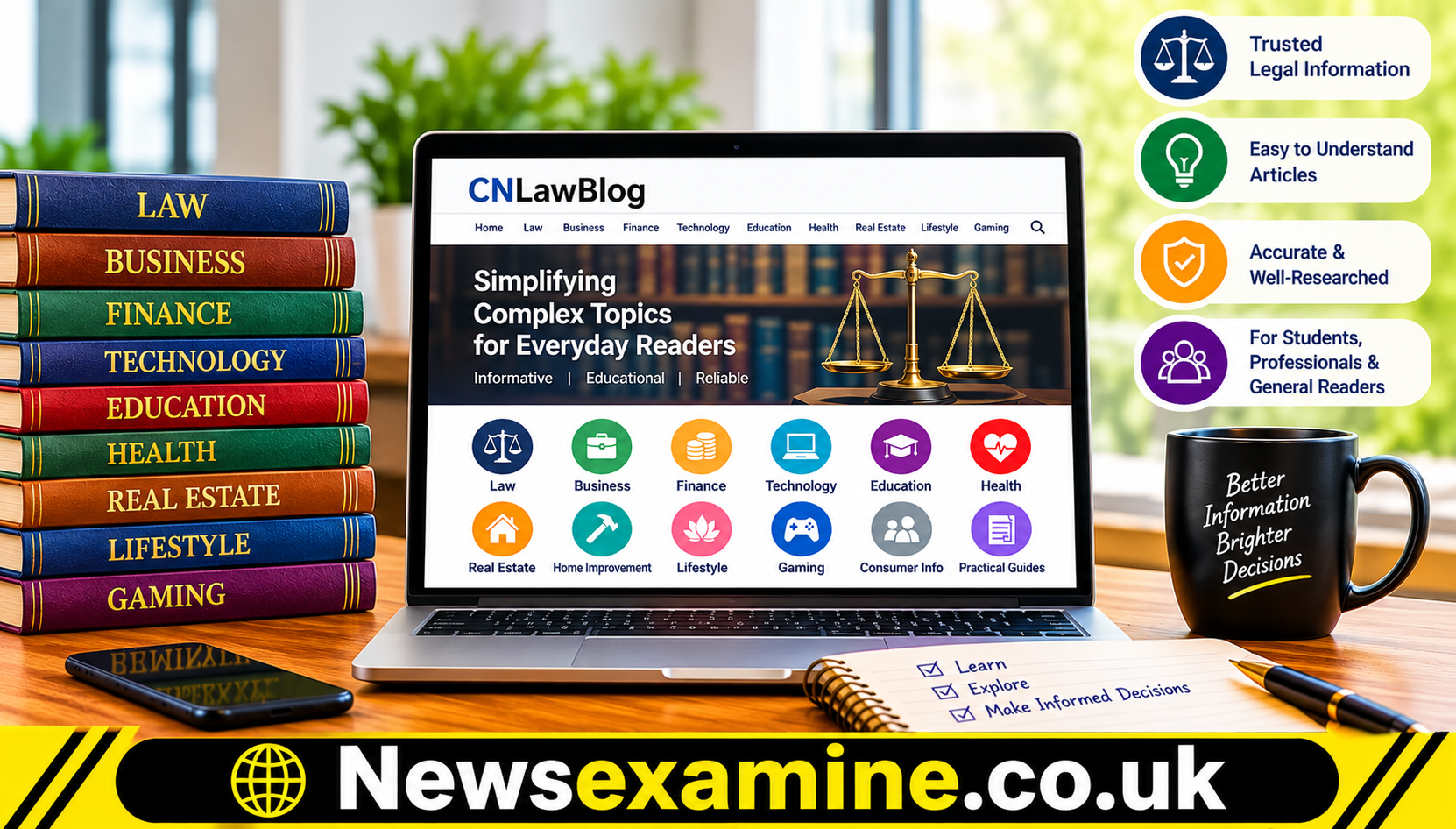
If you searched for cnlawblog, you probably landed on the site and asked the obvious questions: what is it, who runs it, and can you trust it? The short answer is that cnlawblog is the name people use for CNLawBlog.com, an independent, free-to-read publication that started with legal content in August 2018 and has since grown into a general multi-topic magazine covering law, finance, technology, health, business, education, real estate and lifestyle. It is not a law firm, not a court or government site, and not the China Law Blog. This guide explains what the site is, who runs it, what it publishes, and how to judge whether you can trust what you read there — using only facts verified from the site itself, and correcting the claims other guides get wrong.
Key Takeaways
- CNLawBlog is the name people use for CNLawBlog.com, an independent digital publication that is free to read. Its About page says it was founded in August 2018, and the archive contains an article dated 16 August 2018, which fits that date.
- It is not a law firm, not a court, not a government portal and not an official legal database. Its articles are general information, not personal legal advice, and the site tells readers to ask qualified professionals about legal, medical and financial matters.
- It is not the China Law Blog, a separate publication written by the law firm Harris Sliwoski LLP that focuses on Chinese business law. The site is a different publication with a much wider scope, and its About page never says it is about Chinese law.
- Law is only one part of what it publishes: its law categories are accident, civil, corporate, criminal, family and personal injury law, plus CNLaw. The rest covers technology, finance, business, education, health, lifestyle, real estate, gaming and home improvement, with travel, automotive, fashion, politics and sports under a “More” menu.
- Who owns the site is not independently verified. No named founder or owner was found on the site’s public pages, and its homepage bylines show first names only.
- Search results disagree about the site: some guides call it a Chinese-law resource from the early 2000s, and one guest-post seller calls it the official blog of a New York law firm. Only the independent multi-topic publication founded in August 2018 comes from the site itself.
- No scam reports about the site surfaced in the sources reviewed, and it is live and actively publishing with a public archive, a published editorial policy and a disclaimer. That is not a guarantee of accuracy for any single article — rules change, so check important details before acting on them.
- Lookalike domains exist, including cnlawblogs.com (with an extra “s”) and the .co.uk and .org versions. These are separate websites — always check the address in your browser reads cnlawblog.com before trusting a link.
What Is CNLawBlog?
CNLawBlog is an independent online publication at cnlawblog.com. That description comes from the site itself: its About page calls it an independent digital publication founded in August 2018, and a direct check confirms it is live and publishing. The site began with legal writing and has since grown into a broader knowledge platform, which is why its name now understates what it actually publishes.
The best way to understand the site is as a digital magazine rather than a specialist law journal. Its homepage is organised into topic categories, and law is one menu item among many: Technology, Finance, Business, Education, Health, Lifestyle, Real Estate, Law, and a “More” menu. Its articles explain complicated subjects in plain language as guides and explainers rather than formal legal analysis. It does not make law, decide cases or give personal advice, and its disclaimer says its content is for general information and education only.
The site is free to read, with no paywall and no account needed to browse its archive, which runs to 21 pages of posts — a publication posting steadily for years, not one that appeared overnight. Recent homepage posts have included online loan scams, Federal Reserve interest-rate expectations, Treasury yields, artificial intelligence, gaming, parenting and real estate.
The name itself causes most of the confusion. “CN” suggests China to many readers, and “law blog” suggests specialist legal analysis. Neither is a reliable guide to what the site publishes today. The site’s own pages never define what “CN” stands for, and its coverage is not limited to Chinese law. The publication covers legal topics involving several jurisdictions, particularly the United States, alongside a large amount of material that has nothing to do with Chinese law at all. Anyone who cites the site as a source for Chinese regulations should first confirm which site they actually mean.
Quick Facts
| Fact | Detail |
|---|---|
| Website | cnlawblog.com |
| What it is | Independent multi-topic online publication, free to read |
| Founded | August 2018, per the site’s About page; oldest archived post dated 16 August 2018 |
| Law firm? | No — not a law firm, court, government site or official legal database |
| Gives personal legal advice? | No — general information only; the site tells readers to consult qualified professionals |
| Owner | Not publicly disclosed; no founder or editor-in-chief named on the site |
| Main categories | Technology, Finance, Business, Education, Health, Lifestyle, Real Estate, Law |
| More categories | Travel, Automotive, Fashion, Politics, Sports, Gaming, Home Improvement |
| Law categories | Accident, Civil, Corporate, Criminal, Family, Personal Injury, plus CNLaw |
| Archive | 21 pages of posts on the homepage |
| Editorial policy | Published; says articles get human review before publication and sponsored content is labelled |
| Guest posts | Accepted through a Submit Guest Post page; some content is contributed by outside writers |
| Contact email | No public contact email found |
| Same as China Law Blog? | No — that is a separate publication by the law firm Harris Sliwoski LLP |
| Best used for | General background on a topic, before checking a primary source |
What Does It Cover?
Law is still one of the site’s major categories, but it is no longer the whole site. The site sorts its legal posts into accident, civil, corporate, criminal, family and personal injury law, plus a category called CNLaw for posts about the site itself. Those categories cover the legal topics that come up most often in daily life: personal injury claims, civil disputes, criminal law, family law, corporate matters and accident claims.
The rest of the site is a general-interest magazine covering technology, finance, business, education, health, lifestyle and real estate, with gaming and home improvement also appearing, and travel, automotive, fashion, politics and sports under the “More” menu. Recent posts have included online loan scams, interest-rate expectations, Treasury yields, artificial intelligence, gaming, parenting and real estate — a mix that shows law is now one section of a general publication, not its only focus.
Who Runs the Site?
The honest answer is that the ownership of the site is not independently verified. The site describes itself as an independent digital publication, but its public pages do not name a founder, an owner or an editor-in-chief, and its homepage bylines show first names only, so readers cannot check an author’s credentials from the byline alone. That gap matters, and it is the main reason this article does not present the site as a fully transparent publication.
What can be verified is how the site says it works. Its editorial policy describes its approach to research, clarity, factual consistency, review and updates: every article gets human review before it goes live, and digital tools may help with drafting and grammar but do not replace human judgment. It also publishes a disclaimer stating that its content is general information and education, not professional legal, financial, medical, tax or business advice, and its policy says sponsored content is labelled, so readers should look for that label and ask who benefits from it.
The site also has a guest-post submission page, so some content may be contributed by outside writers rather than written by staff, and third-party marketplaces advertise paid guest posts with backlinks on cnlawblog.com. Neither fact proves any specific article is paid, but both are reasons to check whether an article is staff-written, contributed or sponsored before relying on it.
Several independent guides reached the same conclusion: there is no proof of a law firm owner, and the About page says the site is independent. One guide put it plainly — check the primary page before repeating what a third party says. Claims found elsewhere that the site is a New York law firm blog were not supported by the site’s own pages.
The practical point is simple: judge the site by what it publishes and how it publishes it — an editorial policy, a disclaimer, labelled sponsored content and a long public archive — rather than by assuming a law firm or an institution stands behind it. No institution has been verified as standing behind it, and the site should be treated as an independent blog, not as an official source.
Is It Legit?
The site is a real, live publication, and there is no evidence in the sources reviewed for this article that it is a scam. That is a measured statement, and it is worth explaining what supports it and what its limits are.
The evidence in its favour is straightforward. The site is live at cnlawblog.com and has been publishing since August 2018, with an archived article dated 16 August 2018 that matches the founding date on its About page. It has a public archive running to 21 pages, a published editorial policy, a disclaimer, and a practice of labelling sponsored content, and none of the sources reviewed reported scam complaints, fake payment demands or malware warnings connected to the site.
The limits are equally straightforward. Legitimate does not mean authoritative or accurate on every point: the site’s ownership is not independently verified, its authors are identified by first name only, and legal and financial rules change, so an article that was correct when published can become out of date. The site itself warns readers to consult qualified professionals, and readers should take that warning seriously.
Before trusting any single article, check four things. First, confirm the domain is right, not a lookalike such as cnlawblogs.com or the .co.uk and .org versions. Second, check whether the article is labelled as sponsored or contributed, because that is not the same as staff-written editorial content. Third, check the date, the jurisdiction, and whether the rules it describes are still current. Fourth, never treat a blog article as a substitute for a lawyer, especially for a matter with real money, a deadline or a court involved.
The verdict is balanced: the site appears to be a legitimate, free, general-information publication, not a scam and not a law firm. It is useful as a starting point for understanding a topic, not as a primary legal authority. Use it to learn the background, then verify anything important with a qualified professional or a primary source.
CNLawBlog vs China Law Blog
The single biggest source of confusion around cnlawblog is the China Law Blog, and the two are not the same publication. The China Law Blog is written by Harris Sliwoski LLP, an international law firm, and focuses on Chinese business law: trademarks, manufacturing contracts, NNN agreements, intellectual property, trade and foreign investment. Its archive runs past 100 pages.
The site has a different address and a far wider scope. Its About page never says it is about Chinese law, and the letters “CN” in the name do not make it a China source. It covers law alongside finance, technology, health, business, education, real estate, gaming and lifestyle, and its legal posts deal mostly with US topics such as personal injury claims, civil disputes and criminal law. The two sites have different owners, different domains and different editorial focuses, so anyone researching a legal question should check the exact web address before relying on an article.
The confusion is understandable because several ranking guides get it wrong: some describe the site as a Chinese-law resource with roots in the early 2000s, and one claims it grew “over the past two decades” from a niche Chinese legal commentary platform. Those claims describe the China Law Blog, not this site, which was founded in August 2018. If a guide tells you cnlawblog is a Chinese-law specialist, it has mixed up the two sites.
What Does “CN” Mean?
Nobody outside the site can answer this with certainty, because the site itself never defines what “CN” stands for. Its About page says nothing about the letters. The most common guess is China, since “CN” is the country code for China and the site began with legal content, but nothing the site publishes supports that guess, and its coverage is not about Chinese law.
Other guides handle this differently: one asks the question directly and gives the honest answer — the site does not say — while most do not ask it at all, which leaves readers to assume the China connection. The safe way to read the name is as a brand, not a description: what matters is what the site actually publishes, which is a broad multi-topic magazine with a legal section. If you need Chinese business law specifically, the China Law Blog is the publication for that, and it is a different site.
Lookalike Domains: Check the Address Bar
A second confusion comes from domains that look almost identical to cnlawblog.com. Guest-post marketplaces list the site alongside a separate site called cnlawblogs.com, with an extra “s”, and the .co.uk and .org versions also exist. None of these is the same publication, and none has been verified as connected to it.
This matters because a reader who follows a search result or a shared link can easily land on the wrong site and trust it as if it were the one they meant. The check takes two seconds: look at the address bar and confirm it reads exactly cnlawblog.com before you read, share or cite anything. If the address has an extra letter or a different ending, you are on a different website. The same check applies to links inside articles: a link that points to a lookalike domain is not a link to the publication this guide describes.
How to Use the Site
Using the site well means treating it as a research starting point, not a final authority — follow these steps for any article you read there.
Step 1: Confirm the domain. The address should read cnlawblog.com, not a lookalike such as cnlawblogs.com or the .co.uk and .org versions.
Step 2: Find the category and the place. Use the menu to see what kind of article you are reading, then look for the state, country or city it is about — law differs by place, and many of the site’s legal posts name one US state or city. If no place is named, treat the post as very general.
Step 3: Check the date. Legal, financial and technology rules change, and an article that was correct when published can become out of date. Rate and yield posts go stale fastest.
Step 4: Look for a sponsored or contributed label. The site’s policy says sponsored content is labelled, and it accepts guest posts. A labelled article is not necessarily wrong, but it is not staff-written editorial content, so ask who benefits from what it recommends.
Step 5: Match important claims to a primary source. If a post says a law requires something, find the law and read it — Cornell Law School’s Legal Information Institute is a good starting point for US statutes and court opinions. If the article points to no source at all, treat its claims as unverified.
Step 6: Ask a licensed attorney before you act. A blog cannot know your facts, your deadlines or your jurisdiction. Court papers, a contract you are about to sign, an injury claim or a close deadline all deserve an attorney’s review. Use the site to prepare good questions, then bring them to the professional.
Alternatives
The right alternative depends on what you need. For China-related business law, the China Law Blog from Harris Sliwoski LLP is the specialist publication, and it is a separate site. For primary US legal sources, Cornell Law School’s Legal Information Institute (LII) is a free, authoritative resource for federal and state statutes, court opinions and legal definitions. For court opinions, the official court websites and public records are the primary source, not any blog. For general background, judge other explainer sites by the same checks in this guide. For personal legal advice, the real alternative is a qualified lawyer, not another blog.
Frequently Asked Questions
What is CNLawBlog?
It is an independent online publication, founded in August 2018 with a foundation in legal publishing. It has since grown into a broader knowledge platform covering law, finance, technology, health, business, education, real estate, lifestyle, gaming and home improvement. It is free to read, and its articles are general information in plain language.
Who runs CNLawBlog?
The ownership of the site is not independently verified. The site describes itself as an independent digital publication but does not name a founder, owner or editor-in-chief on its public pages, and its homepage bylines show first names only. It publishes an editorial policy and a disclaimer, and its policy says sponsored content is labelled. It is not run by a law firm, and no law firm affiliation has been established.
Is CNLawBlog legit and safe to use?
The site appears to be a legitimate, free, general-information publication. It is live at cnlawblog.com, has published since August 2018, has a public archive of 21 pages, a published editorial policy and a disclaimer, and no scam reports about it surfaced in the sources reviewed. It is safe to read in the ordinary sense, but it is not a law firm and not a primary legal authority, so do not act on important legal or financial matters based on a blog article alone. Always check the domain is right, check for a sponsored label, and verify important details with a qualified professional.
What does CNLawBlog cover?
It covers law alongside many other subjects. Its law categories are accident, civil, corporate, criminal, family and personal injury law, plus CNLaw. Its other categories cover technology, finance, business, education, health, lifestyle and real estate, with gaming and home improvement also covered, and travel, automotive, fashion, politics and sports under a “More” menu. Recent topics have included online loan scams, interest rates, artificial intelligence, gaming, parenting and real estate. Law is one section of a general publication, not its only focus.
Is CNLawBlog the same as China Law Blog?
No. The China Law Blog is a separate publication written by Harris Sliwoski LLP, focused on Chinese business law such as trademarks, manufacturing contracts and NNN agreements. The site discussed here is a different publication with a much wider scope, and its About page never says it is about Chinese law. The letters “CN” in the name do not make it a China source. Anyone researching a legal question should check the exact web address before relying on an article.
What does “CN” mean in CNLawBlog?
The site never defines what “CN” stands for, so there is no verified answer. The common guess is China, since “CN” is the country code for China and the site began with legal content, but nothing on the site supports that reading, and its coverage is not about Chinese law. The name is best read as a brand rather than a description. If you need Chinese business law, the China Law Blog is the publication for that, and it is a different site.
How do I use CNLawBlog?
Use it as a starting point, not a final authority. Open the site and confirm the address reads exactly cnlawblog.com, browse by category or search for your topic, and read the article for background. Then check the article’s date and jurisdiction, look for any sponsored-content label, and verify anything important with a qualified professional or a primary source such as Cornell Law School’s Legal Information Institute. If you need personal legal advice, speak to a lawyer in your own jurisdiction rather than relying on a blog article.
How do I contact CNLawBlog?
No public contact email for the site was found in the sources reviewed, so no email address is given here. The site has a guest-post submission page — the public route for contributed content — and its editorial policy says readers can report mistakes through its contact page. Readers who want to reach the site should use the contact or submission options shown on the site itself, and should first confirm the address reads cnlawblog.com, since lookalike domains such as cnlawblogs.com and the .co.uk and .org versions are separate websites.
